Nearly seven years ago, my first niece was born. At that point, I'd been knitting, sporadically, for a few years. I knew how to knit, purl, increase and decrease but I was, for all intents and purposes, a beginner. However, the promise of a new baby in the family inspired me to knit a baby blanket. I knew my sister-in-law would be thrilled with a handmade gift for her first child.
Cassandra gave me the pattern. It came from a magazine and had been a first place winner in a Knit and Crochet Crafts contest. The appeal of the pattern was that the finished product would look the same front and back and it only called for knit and purl stitches. The scary part was that it was a six row repeated pattern which, at the time, seemed very complicated.
I bought a gorgeous peach colored cotton and set to work. While on the third skein of yarn, I made a mistake in the pattern. Being a beginner, I had no confidence or skill for fixing problems in my knitting so I took the blanket to my local yarn shop and begged some help. Unfortunately, I soon found myself facing the same problem again. I'm sure I mis-counted my rows or something but I couldn't fix it. My niece was born with her baby blanket about one-third done.
The unfinished project went into limbo.
Less than two years later, my sister-in-law was pregnant with her second child. The forgotten project was trotted out and I took it to my new knitting group, the very first time I went to a meeting, to beg some more help. Someone ripped out a bunch of it and showed me where to start in the pattern again. I probably got another dozen rows done before I screwed it up again. Too embarrassed to admit that I couldn't correct my mistake, the blanket went back in the closet.
 |
| My niece at three. The blanket had been abandoned twice at this point. |
Fast forward to this past weekend and my family reunion in upstate NY. I didn't have any summer knitting projects but wanted something to take on the plane. Knowing that I was going to see my sister-in-law and now-seven-year-old niece, I thought it would be funny to take the blanket to show them. Since I hadn't looked at it in five years, I also figured I might have gained enough skill to actually tackle the corrections on my own.
I broke out the old project and was thrilled to see that the color still appealed to me and the cotton felt okay against my hands in the summer heat. I was surprised to see that the work was on metal needles as I haven't used metal in years and generally dislike the way they knit. Then I unfolded the dreaded pattern that had given me such heartache. Two things struck me right away - I was using the original copy of the pattern (something I'd never do now for fear of spilling tea on it or losing instructions from wear on the folds) and the margins were marked with all these hieroglyphics that I'd used to keep track of where I was in the pattern. These were sure signs of what a novice I was when I'd worked this project in the past.
 |
| novice tracking method |
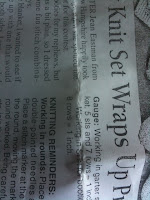 |
| folds = indecipherable instructions |
Then I started trying to decipher my mistake. The Alex of today - a solidly intermediate knitter - is able to count stitches based on the pattern (purl bumps versus knit stitches are obvious to my eye now) and even look back a number of rows to find a problem. She can also rip out rows without having a complete heart attack.
It took me two tries to find and correct my mistake. At first, I simply counted my previous rows and determined where I needed to pick up the pattern. Turned out that wasn't right and the pattern was, essentially, reversed. So, I ripped back to a point that I knew to be the last pattern row (row number six) and then, before knitting the next row (pattern row number one), I looked at the work and visualized how the knitting would appear if I knitted that pattern row. It seemed to be right, so I forged ahead. And it was right. As were the subsequent rows.
 |
| Still a work in progress |
Of course, I'm hyper-sensitive to making sure I'm working the right pattern row so I'm constantly checking to make sure I haven't veered off track. So far, so good.
The thing I find most interesting is how far I've come with my skills. Five years ago, I had no idea how to fix the problems with this project - looking at the pattern and work in progress was like trying to read Greek (which I don't do, obviously). Today, I understand the pattern and the completed work in an entirely different way. It also helps that I'm not afraid to deconstruct what's wrong and rebuild it.
Progress is an amazing thing. I have an entirely new perspective on my abilities as a result of this experience and I'm thrilled that I'm finally going to finish this damn blanket.
Footnote: I told the story to my sister-in-law who thought it was hilarious. I also showed my niece who a) LOVED the blanket and still wants it and b) wants to learn to knit now. I taught her how to do a knit stitch and there are about twenty stitches in the blanket that were done by her hand. Yea!!
- Alex


 cables you see on sweaters. This is a very interesting technique that requires taking stitches off your needles and picking them up again later to place them "over" the other stitches.
