
So, what am I doing with my copious non-crafting time? Passive entertainment... Books, TV, games, and social media have been my constant companions for the last few months. Some of it has had some value - books where I've actually LEARNED something, for example - but most of it has just been diversion. Regardless, I thought you might like some recommendations... just in case you need some diversions as well. :)
- Alex
Disclaimer: Obviously, entertainment is a very subjective thing. Just because I like it, doesn't necessarily mean you will. I'll try to be as descriptive as possible and not steer you wrong.
Books
- Mr Penumbra's 24-Hour Bookstore by Robin Sloan

Global conspiracy, complex code-breaking, young love, and the secret to eternal life — mostly set in a hole-in-the-wall San Francisco bookstore. The Great Recession shuffles Clay Jannon from his web-design drone job to night shift at Mr Penumbra’s 24-Hour Bookstore. Curiously, few customers come in repeatedly and never buy. Analysis reveals astonishing secrets that take the reader from the birth of printing to Google and back.
- The Paradox of Choice by Barry Schwartz
A social critique of our obsession with choice, and how it contributes to anxiety, dissatisfaction and regret. Whether we’re buying a pair of jeans, ordering a cup of coffee, selecting a long-distance carrier, applying to college, choosing a doctor, or setting up a 401(k), everyday decisions--both big and small--have become increasingly complex due to the overwhelming abundance of choice with which we are presented.

In The Paradox of Choice, Barry Schwartz explains at what point choice--the hallmark of individual freedom and self-determination that we so cherish--becomes detrimental to our psychological and emotional well-being. In accessible, engaging, and anecdotal prose, Schwartz shows how the dramatic explosion in choice--from the mundane to the profound challenges of balancing career, family, and individual needs--has paradoxically become a problem instead of a solution.
- Empty Mansions: The Mysterious Life of Huguette Clark and the Spending of a Great American Fortune by Bill Dedman and Paul Clark Newell, Jr.
Empty Mansions is a rich mystery of wealth and loss, connecting the Gilded Age opulence of the nineteenth century with a twenty-first-century battle over a $300 million inheritance. At its heart is a reclusive heiress named Huguette Clark, a woman so secretive that, at the time of her death at age 104, no new photograph of her had been seen in decades.
Dedman has collaborated with Huguette Clark’s cousin, Paul Clark Newell, Jr., one of the few relatives to have frequent conversations with her. Dedman and Newell tell a fairy tale in reverse: the bright, talented daughter, born into a family of extreme wealth and privilege, who secrets herself away from the outside world.
The Clark family story spans nearly all of American history in three generations, from a log cabin in Pennsylvania to mining camps in the Montana gold rush, from backdoor politics in Washington to a distress call from an elegant Fifth Avenue apartment. The same Huguette who was touched by the terror attacks of 9/11 held a ticket nine decades earlier for a first-class stateroom on the second voyage of the Titanic.
Empty Mansions reveals a complex portrait of the mysterious Huguette and her intimate circle. We meet her extravagant father, her publicity-shy mother, her star-crossed sister, her French boyfriend, her nurse who received more than $30 million in gifts, and the relatives fighting to inherit Huguette’s copper fortune. Richly illustrated with more than seventy photographs, Empty Mansions is an enthralling story of an eccentric of the highest order, a last jewel of the Gilded Age who lived life on her own terms.

- The Returned by Jason Mott
All over the world people's loved ones are returning from beyond. No one knows how or why this is happening, whether it's a miracle or a sign of the end. As chaos erupts around the globe, Harold and Lucille Hargrave, newly reunited with their 8 year old son who died 40 years earlier, find themselves at the center of a community on the brink of collapse, forced to navigate a mysterious new reality and a conflict that threatens to unravel the very meaning of what it is to be human.

With spare, elegant prose and searing emotional depth, Jason Mott explores timeless questions of faith and morality, love and responsibility. A spellbinding and stunning debut, The Returned is an unforgettable story that marks the arrival of an important new voice in contemporary fiction.TV
- Marvel Agents of S.H.I.E.L.D.

After the Battle of New York, the world has changed. It now knows about the Avengers and also about the powerful menaces that require those superheroes to face them. In response, Agent Phil Coulson of the Strategic Homeland Intervention, Enforcement, and Logistics Division (SHIELD) assembles an elite, covert team to find and deal with these threats whenever (and wherever) they're found.
- The Goldbergs
The Goldbergs is set in the 1980s and follows the Goldberg family. Starring Jeff Garlin as husband Murray, Wendi McLendon-Covey as wife Beverly, and three children. Youngest son, Adam, documents their lives with his video camera. The series is based on creator Adam F. Goldberg's real-life family, in which he actually video-taped events when he was growing up, which are re-enacted throughout the program.

- The Blacklist

Raymond "Red" Reddington, one of the FBI's most wanted fugitives, surrenders at FBI Headquarters in Washington, D.C. He claims the FBI and he have similar interests in getting rid of dangerous criminals and terrorists. Reddington will cooperate only with Elizabeth Keen, a rookie FBI profiler. Keen questions Reddington's sudden interest in her, but Reddington will only reveal that she is very special. After the FBI uses Reddington's information to locate a terrorist, Reddington reveals that this terrorist is only the first of many criminals that he will help them neutralize. Over the course of his own criminal career, he has made a list of global criminals who he believes are truly dangerous to society, most of whom are unknown to the FBI. Reddington calls it "The Blacklist".
- Dancing on the Edge
GamesThis six episode mini-series from the BBC follows a black jazz band's experiences in London in the 1930s. Made up of talented musicians and managed by the compassionate yet short-tempered Wesley Holt, the band gets a gig at the Imperial Hotel, by the way of the cunning journalist, Stanley Mitchell. They prove to be a hit, and become a success at the hotel. Countless aristocrats - and the Royal Family - ask the band to play at parties. The media rush to interview and photograph the band - including the ambitious American businessman, Walter Masterson and his enthusiastic employee, Julian. The band's success spirals, being offered record deals. But tragedy strikes, setting off a chain of events that may wreck the band's career.

- Dixit (a great game for ALL ages - even kids)
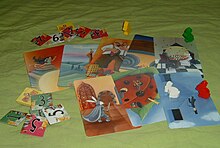
Each player starts the game with 6 random cards. Players then take turns being the storyteller. The player whose turn it is to be storyteller looks at the 6 images in his hand. From one of these, he makes up a sentence or phrase and says it out loud (without showing the card to the other players).
The other players then select among their 6 images the one that best matches the sentence made up by the storyteller.Then, each of them gives their selected card to the storyteller, without showing it to the others.
The storyteller shuffles his chosen card with all the cards he received from the other players. All pictures are then shown face up, randomly, and every player has to bet upon what picture was the storyteller's.
If nobody or everybody finds the correct picture, the storyteller scores 0, and each of the other players scores 2. Otherwise the storyteller and all players who found the correct answer score 3. Players other than the storyteller score 1 point for each vote their own pictures receive.
The game ends when the card deck is empty. The player with the highest point total wins the game.
- Cards Against Humanity (XXX rated. Do not let your children anywhere near this deck of cards. But it's hilarious, if you can stand how offensive it is)
Game play is nearly identical to Apples-To-Apples. To start the game, each player draws 10 white "answer" cards. One randomly chosen player begins as the Card Czar, and plays a black "question" card. The Card Czar reads the question out to the group. Each player answers the question by passing one white "answer" card, face down, to the Card Czar. The Card Czar shuffles all the answer, reads them out loud in a humorous fashion, and picks their favorite. Whoever played that "answer" card gets to keep the black card as one point. After each round, a new player becomes Card Czar, and every player draws back up to 10 cards.

- Plants vs Zombies 2: It's About Time
In Plants vs. Zombies, players place different types of plants and fungi, each with their own unique offensive or defensive capabilities, around a house in order to stop a horde of zombies from reaching the house of the residents. The playing field is divided into 5-6 horizontal lanes, and with rare exceptions, a zombie will only move towards the player's house along one lane (the main exception is if it has taken a bite out of a garlic). Planting costs "sun", which can be gathered for free (albeit slowly) during daytime levels and by planting certain plants or fungi. Most plants can only attack or defend against zombies in the lane they are planted in. In later levels, players can purchase upgrades with different offensive and defensive abilities.


