Showing posts with label gardening. Show all posts

How Does My Garden Grow?

This week my garden grows in bags. :)

In case you missed it, this cool gardening tactic has been making the rounds on Facebook lately. Bag gardening isn't new - just do a Google search and you'll yield thousands of results. However, the blog post that has been referenced on FB presents the idea in what I think is a better way. It brings the height of the garden up to waist level (for me, anyway) and out of the reach of the voracious bunnies that live in my neighborhood.

So here, in pictures, is my adventure in bag gardening. Easy to do - took me one shopping trip and about a half hour to plant. I'll post updates as the bags grow (or don't!). And please, send us pics if you do this too. I'd love to see your results.

- Alex

Shopping list:

2 wooden sawhorses (Home Depot) - $19 ea - reusable for many jobs
1 piece of cow fencing - cut to 3' widths (Farm & Fleet) - $20 for eight finished cuts
4 one cubic foot bags of garden soil (Home Depot) - $5 ea
Seeds for shallow rooted plants (herbs, greens, etc)

You'll also need a utility knife or some other sharp knife or scissors.

This is what cow-fencing looks like.
Two sawhorses, one cut of cow-fencing, holds four bags of soil.
Poke holes in the bottom of the bags for drainage.
Cut open the top of the bag, leaving about a 2"-4" border.
Like this. Leave the "flaps".
Loosen the soil.
Remove and retain the top layer of soil (you'll reuse this).
Shallow-rooted seeds.
Sow the seeds per the package instructions.
Use the removed soil to cover the seeds.
Roll the flap up and tuck them in the sides. This provides stability.
I used the seed packets to mark my plantings.
My finished bag garden!
Fingers crossed, I should have a fabulous garden of greens for my summer eating!


Growing Garbage

When I was a kid, I had a book with Fisher-Price level "experiments" meant to stimulate an interest in science-y things. I don't remember anything from the book except for one thing, the "how to grow carrot tops" experiment. 

The line drawings in the book were perfect for a very young mind - simple, clear, and vaguely cartoonish - and the instructions were easy to follow. I was obsessed with the idea that I could take the cut tops of the carrots and grow frilly green bits from them. Somehow, I knew that I wasn't going to get actual carrots from the growth, just a cool garden of green.

The instructions said to place a layer of small stones (like the kind you put in the bottom of a fish tank) in a container and cover the stones with water. Then you take the cut carrot tops, preferably with some healthy green shoot left on it, and place on top of the stones. Place in a sunny window and, voila!, you get fresh growth. Endlessly fascinating. 

Sadly, I have no memory of my mother actually helping me do this experiment...

Perhaps that's why, lo these decades later, I still want to grow stuff from old kitchen scraps. Which would explain why THIS book is now in my house:


LOOK! Even the drawings are similar to the ones from my childhood book!! It was fate.

Basically, Don't Throw It, Grow It by Deborah Peterson is an expansion on the carrot top idea - grow decorative (not fruiting/vegging) stuff from the plant scraps you would normally toss out. Vegetables, fruits & nuts, and herbs & spices each have a chapter. Then, just for fun, there's a chapter on plants from Latin America and plants from Asia. I guess they assume that some of us have mercados and Asian markets at our disposal. The best part is that they kick off the book with a great chapter on the basics of growing plants, boldly proclaiming that there's no such thing as a black thumb. :)  While it's written for adults, I think that a precocious 8 year old could probably get a lot out of this book and maybe remember it 40 some odd years later. I'm just sayin'.

In retrospect, I wonder if my early exposure to that book on growing carrot tops was what started my love of gardening or if my obsession was an indicator of things to come. Either way, it's January and it's cold... and I'm thinking about planting. :)

Happy gardening, friends.

- Alex


Ladybug: Aphid Killer

Ladybugs are cute - all red and polka-dotted. In childhood books they're portrayed as sweet and adorable.


In realilty, ladybugs and their more aggressive cousins, the Asisan beetle, are stone cold killers.


As I have mentioned (probably ad nauseum), I have a severe infestation of black cherry aphids on my lovely, beloved cherry tree. I've tried a lot of things to eradicate them. The first year, I got so frustrated, I actually used a nasty chemical - against my better judgement. It didn't work. So, for the last couple of years, my tactic as been to manually remove the infested leaves and treat the entire tree with organic insecticidal soap. Yeah... not so much.

At the end of last summer, I did serious research on how to get rid of the little buggers. However, I missed a critical piece of information - the one that said "do all this in the fall". I waited until spring and, of course, by then it was too late to do the preventative stuff. So, I was back to picking off leaves and spraying soap in hopes of keeping them under control. My last ditch effort was the one that I had the least faith in - buying live predators and realeasing them on the tree to kill the aphids.

I read too much online to have any faith in buying ladybugs to eat the aphids. Most of the reviewers complained of releasing $40 worth of ladybugs only to see them fly off into the sunset (or to the neighbor's yard). Short of putting a net up to keep them on the tree, I couldn't imagine that this tactic would work at all.

But... desperate times call for desperate measures. I ordered 3,000 ladybugs - two packages of 1,500 from two different suppliers (just in case one was a dud). I also ordered some ladybug "lure" which is supposed to make the tree irrisistable.

Here, in photos, was my experience:

Box #1 - Nicely packaged. Good air holes. Well branded box.

Box #2 - hand-made airholes. No branding on box. Giant "live ladybug" sticker on top.

In box #1 - a vial of nectar concentrate. Enough to make 1 qt of nectar to feed the bugs.

Box #2 - a bag of nectar powder. Enough to make about 1 at of nectar.

Both sets of bugs came in this type of plastic mesh bag.
At this point, I'd like to point out some differences between my two shipments. Box #1 included a lot of stuff that box #2 didn't (or didn't do as well.) Box #1 had lovely, 4-color inserts with information on the lifecycle of the bugs and how to release them, cross-sell on a bunch of other cool ladybug stuff (including kits for kids), and a coupon for 10% off my next purchase. Box #2 had two sheets of typed information that explained about ladybugs and how to release them. They were copied on green paper.

The biggest difference between the two was the health of the bugs. Box #2 had about 1/2 inch of dead ladybugs in the bottom of the bag. Now... I'm still sure I got my 1,500. There were TONS of live bugs in there. But they were rather weak which, when it was all said and done, worked in my favor. Box #1 had a total of 7 dead bugs in the bag. Seven. Seriously. And all the bugs were super-active and seemed very healthy. This could have been attributed to the fact that box #1's bag had a small piece of "feeding cotton" in it. I'm sure it was soaked with nectar. So, why were the weaker bugs better?? Because they immediately sought out food (the aphids) and they didn't disappear as quickly. The healthy bugs in box #1 ate some, but were perfectly content to fly off.

Check this out:


After releasing the ladybugs, a lot of them stayed around and feasted on aphids. If the information in box #1 is to be believed, they will have laid some eggs and will hatch larvae that will continue to eat the aphids - thus controlling the pests completely. Who knows. Out of 3,000 bugs, there were probably a few hundreds left on the tree after a day. Maybe that's all it takes...

Regardless, the process was fun and it was great to see the bugs do what they were meant to do. Fingers crossed!

- Alex

All in a Day

One of the books read over-and-over in our house is All in a Day by Cynthia Rylant and illustrated by Nikki McClure. It is a poetic account of the big and little things that happen in a day of a young farm boy's life. Yesterday felt like our own All in a Day story. And I caught some of it with my camera.


: Beginning to introduce native woodland plants into our modest patch of wilderness


: PB&J picnic with my babies (and daughter's helpful boyfriend)


: The garage was a noisy place with planter boxes being made by my husband and father-in-law for the tomatoes spouted on the windowsill by the littles


: Certain little boys needed a shower and a little Mr. Rogers Neighborhood after a day in the sunshine


: Some work that did not fit in today


: And then, at the end of the day, being gently reminded to stop and be present for a snuggle moment on the couch

Trying to photo capture a simple day at home sort of happened spontaneously. Most of this day I was covered in dirt without a camera in sight. And certain photos may be a little fuzzy, but not every little moment is photo-friendly. But, it was a good experiment and I think I'm going to try it again...maybe more mindfully this time. 

I'm wondering, how was your day?

–Cassandra

My Love Affair with Willow

I'm sure I've mentioned it about a million times now but, just for safety's sake, I'll say it again - Madison is a unique place, full of unique people and opportunities.

One of my favorite, unique-to-Madison occurrences are the annual "Plant Guys" sales. The Plant Guys are a group of friends who garden perennials and then sell them "yard sale" style at their homes. Generally, there are about 6  sales per spring season and you can buy nearly any kind of perennial you can imagine. I can honestly say that about 80% of the plants in my yard are from the plant guys. They've introduced me to so many types of flora, I can't begin to describe their impact on my gardening.

Last year, they sadly announced would be their last. They were retiring after lord-knows-how-many-years of doing these sales. More time to spend on their own (glorious, I might add) garden. I nearly broke down in tears as I paid for, what would certainly be my last, Plant Guys purchase. I hugged them both even though I'm sure they have, at best, a vague memory of who I am...

The thing is, because of the threat of never having this resource again, I bought LOTS more stuff than normal -  including a curly willow tree. I figured I'd find somewhere in my garden to plant it...

My fave neighborhood curly willow.
 The one of the plant guys gave me the rundown on the curly willow:
  1. It is super-hearty 
  2. It can be grown from cuttings (that's how they propagate new ones to sell - they just trim their own tree)
  3. It can be left to grow in a pot (ever bigger pots as the tree gets bigger) for YEARS
  4. It can be totally neglected over winter and will still bounce back in the spring
  5. It is curly!
I looked at their mature tree - planted against a side fence - and wasn't crazy about the way they had it pruned. However, I knew I didn't have to prune it the same way.

I looked at their "teenaged" plant - still in a GIANT pot - and loved the way it looked with all it's crazy curly branches.

And I took one home.

It did great all summer. Lots of delicate little leaves on an ever-expanding system of little, curly branches. My neighbors all asked about it. I put it in a larger pot and took great care of it.

When fall came, the leaves dropped and I, dubiously, put the tree, in its pot, in the garage and neglected it for nine months. As soon as I knew that the temperatures wouldn't drop to freezing again, I brought back out to the patio, soaked it with water and waited. About a week later, I had baby leaves. I couldn't believe it!

My willow - still in the pot - after being neglected all winter. LEAVES!

A week or so later, I was walking the dogs and noticed a HUGE pile of curly willow cuttings in front of one of my neighbor's houses. I ran home, got my clippers and went back to salvage some cuttings. I wanted to see if I could propagate curly willow too. The neighbor was all too happy to let me take as much as I wanted. So I cut a bunch - all different size pieces - and put them in a huge vase of water in the middle of my dining room table. A friend called it the Tim Burton centerpiece.

Lo and behold, within a few days I had baby roots sprouting. This past weekend, I bought pots, picked the healthiest looking trimmings and potted them.  So far they seem to be doing well. Fingers crossed!

My willow babies

This phenomena of propagating from cuttings means that the plant has some special kind of rooting hormone. As it turns out, you can "harvest" this hormone and use it to help other plants to root. I found this amazing tutorial, from Mr Brown Thumb, on how to make your own "willow rooting hormone" for use on seedlings, plants, etc. All you need are some willow branches, a mason jar, and some hot water. Easy-peasy!

My friend, Johanna, says that curly willow is an invasive species and, as such, she is not supportive of my growing them but I love them. I love their crazy curly branches and their even crazier ability to live all winter with no water or sun. I love their tenacity and their flexibility. I aspire to be as awesome as the willow.

- Alex

P.S. My cherry tree is blooming!

Summer Has Sprung

For the third year in a row, Wisconsin has not had a proper springtime. We have, essentially, jumped from winter (and 30 degree weather) to summer (and 70 degree weather). Frankly, I would really like a transition... but that just me, I guess.

This past weekend we were graced with temperatures in the high 60's and low 70's so, when you have so few months of decent weather, you don't let days like these go to waste. After a rollicking night out on Friday (my bookclub's second anniversary party which resulted in excessive imbibing and bowling until 12:30a.m.), I got my hungover butt out of bed, drank a bunch of water, and started doing yardwork at 9a.m.

The interesting thing about working off a hangover is that there's this moment when you're absolutely positive you're not going to make it and then, suspiciously, you get over it and, between the sun and the fresh air, you suddenly feel great! Or, at least, that was my experience on Saturday.

Because I'm a lazy gardener, I didn't clean out my planting beds at the end of last summer. Saturday's efforts were spent on yard clean-up - raking leaves, digging up volunteer trees, and pulling some of the early, aggressive weeds. At the end of two and a half hours of hard labor, my son, his girlfriend, and I had filled 8 giant leaf bags with yard waste to go to the landfill and (becuase we ran out of bags) left a huge pile of leaves at the curb. My yard is far from finished but I felt an amazing sense of accomplishment getting the beds clean and ready for mulch and new plants.

Inside the house got a smidgen of attention on Sunday with a bit of cleaning and some general moving around of stuff. House plants got moved to the porch and the grill got cleaned and used for dinner. But, the best part of our sunny, 70 degree day was taking my dogs to my friend's farm for a run-about. They spent three hours smelling smells, running in the sun, and chasing the teenaged pigs around the barn. There's nothing funnier than watching a 10 lbs miniature pinscher herd pigs that are four times its size. I wish I'd remembered to bring a camera...

Actually, the best part might have been the fact that the dogs slept the sleep of the dead last night. I can't remember the last time they were so exhausted.

I rounded out my first weekend of summer with a visit from a friends who's learning to knit. We had dinner and then set out to review her work to date and get her going again. She had been to two previous knitting "events" with friends and had a basic understanding of knit stitch. But, she also knew that her fabric (which was about four inches long) was kind of a mess. She had a number of dropped stitches and her tension was pretty uneven so her work looked like that of a beginner (surprise!). So, we ripped out her work and started her on a new piece. I think that, having someone right next to you to talk through problems row by row, really makes a huge difference. She knit about 20 rows and managed to keep her tension pretty consistent and only made a few mistakes (so she also got to see how to fix them). One thing I'm learning about beginning knitters is that it's not unusual for them to "twist" their stitches - usually by throwing their yarn the wrong way around the needle. She did this very consistently but I was able to show her what she was doing and why doing it the "right" way was better. It's going to take some practice for her to change the bad habit but now that she knows how to identify what she's doing wrong, I think she'll get there sooner rather than later.  Oh! I also got her off the insanely long metal needles she was using and onto some nice, easy-to-handle bamboos.

I find that I rather like teaching people how to knit. :)

Finally, in this personal ramble of mine, I'd like to update you all on my allergic reaction that I wrote about last week. Turns out that it wasn't the soap! *yea! I can still use my awesome new felted soap!*  Sadly, it turns out that I had a reaction to an antibiotic I was taking... This is bad for many reason, the worst of which is that I LOVE the Z-Pack and may never be allowed to take it again. Grrrrr.  Also, pretty bad is the fact that, because the meds stay in your system for 10 days, I'M STILL ITCHY!  Although it's much better since I'm taking a cocktail of allergy meds and lathering myself with anti-itch lotion every day.

I hope that, like us, you all  are enjoying glorious weather - wherever you are. All hail summer! Let the gardening begin.

- Alex

Sprout It!

Homesteading - the resurgence of self-sufficiency - has really gained momentum in recent years. Some take it to extremes and it becomes "survivalism" (see: Doomsday Preppers), but for many, it's simply a back-to-basics way to reclaim the skills of our past. This becomes more and more appealing as we face a future that's so completely immersed in and dependant upon technology. There's something very comforting about the authenticity of gardening, canning, and making your own whatever. In one of my previous posts, I waxed jealous about all the cool crafting ideas that come from this movement.

Amazon has this new thing they do called "add-on items" where, at the time of checkout, they serve up a few, inexpensive things tangetially related to what you're purchasing. They are, essentially, impulse buys. The incentive is that you get free, two-day shipping. Of course, this isn't an incentive to those of us who already have Amazon Prime but it's still kind of fun to be offered these little by-the-cash-register items.

So, when I bought a couple of homesteading-related books recently, imagine my delight when I was served up an Amazon Add-On of a "sprout lid" for wide-mouthed Mason jars. For only $2?! Count me in!


Here's the deal with me and sprouts... I LOVE alfalfa sprouts. I could put them on everything. However, I rarely finish an entire container of store-bought sprouts before they go bad. And, as we all know, Alex hates wasting food. So the idea of sprouting at home has always been appealing.

I thought I'd buy some seeds locally but never got around to it and then, one night, I just pulled the trigger and bought them, online through Amazon, from the same people, The Sprout House, who brought me my lid. For $15 I got enough alfalfa seeds to last me for a really, really long time.


Thus began the sprouting adventure.

Holy cats. If I'd known it was this easy, I never, ever would have bought them from the store! Here, in pics, is how I went from seeds to edible sprouts in three days:


Step 1: Put seeds in jar. I used two tablespoons.

Step 2: Soak in water for 8-10 hours.

Step 3: Drain all water.
You'll notice that the seeds are sticking to the sides of the jar. I read online that this was a good thing to do - swirl them up and allow them to stick. It helps to keep them from sitting in any leftover water in the jar (which will rot the seeds). My friend, SSAF, recommended tilting the jar upside down (sorry I didn't get a pic of that) to ensure that any leftover water would drain out. So, I just propped it up against the backsplash of the counter and put a folded paper towel under the jar. Don't put the jar fully upside down or you'll trap the moist air in the jar. Tilt it.

12 hours in. They're growing!!!
After the initial soak/drain, you must rinse and drain the seeds twice a day. I did as part of my morning routine and just before I started cooking dinner.

And this is what happened after just three days: 

Approximately 1 C of edible sprouts
A small amount of unsprouted seeds.
One thing I learned was that not all the seeds will sprout at the same time, that's why you end up with a few unsprouted or only partially sprouted when most are ready to eat. I haven't quite figured out what my next move is... Do I keep the sprouts in the jar and refridgerate the whole thing? Do I remove them from the jar and put them in some other container (this would allow me to keep rinsing the unsprouted seeds...)  I'll keep working on it and, hopefully, become a master sprouter. Frankly, it's so easy, I'm starting to think that I need to buys some additional, different seeds soon... Maybe something spicey.

Oh! If you don't want to buy the little plastic lid, you can use a double layer of cheesecloth under a Mason jar ring.   :)

Cassandra asked me what the nutritional value was of sprouts. I had no idea because I don't usually care when the item is a salad ingredient. But I thought I'd look it up and let you know. So, basically, not a lot. 5% of the USDA daily allowance of Vitamin C, some Vitamin A, a little Calcium and Iron. However, I did find this amazing nutritional site, Self Nutrition Data.

Sprout it!! (maybe that's the next Portlandia skit).

- Alex

If I Can, You Can Can.

Nary a week goes by when I'm not distracted by yet another challenge. And, in case you haven't noticed, in the summer months my particular bent is toward food - growing, harvesting, cooking, storing, eating. You get the picture.

So, in keeping with summer tradition, I tried something brand new (to me): canning.

Interestingly, when I mentioned to one of my social media acquaintances that I was going to try canning, the response I got was, "I'm not crazy about food kept in cans." Which made me laugh because I'm just homey enough to have an innate knowledge that "canning" means "putting stuff up in Mason jars" - even though I didn't have a clue what the process actually entailed.

What prompted this Little House on the Prairie activity was not Cassandra (heh, heh) but was a trip to my CSA (Community Supported Agriculture) farm for one of the annual U-Pick Tomato events. As part of my share, I got to pick 10 lbs of tomatoes for free and as many additional pounds as I could carry for $1.50 a pound. So, yeah... I came home with 25 lbs of tomatoes along with basil, garlic, and a bunch of tomatillos (which I don't know what to do with). Fortunately, I split the tomatoes with someone. :)

Not really sure what to do with tomatillos other than salsa verde...

Even after splitting I was left with nearly 15 lbs of roma and heritage sauce tomatoes to process. Here's how it went down:

That's a lot of tomatoes!

First, I borrowed my friend's canning equipment (except for the Mason jars, which I always keep around the house). This is a critical step because, if it had turned out that I hated canning, at least I wouldn't have purchased the equipment.

Suzanne's giant canning pot dwarfing my soup pot.


Next, I looked up a good, step-by-step video instruction on YouTube. I ended up following the efficient and no-nonsense Ball Canning's video called, simply, "Canning Tomatoes With Ball Canning". It's like they made the video just for me!


The most crucial step was setting up the various tools needed to do the process. It's sort of an assembly-line thing so it's good to have everything lined up and ready to go. Also, because the canning pot is SO HUGE, you really have to start the water well in advance in order to bring it up to boil. So, I had a small pot of hot water (not boiling) to soak the jar lids in, a soup pot of slow boiling water to immerse the tomatoes in and a bowl of ice water to immediately stop any cooking of said, immersed tomatoes, a cutting board and knife, warmed up Mason (Ball/Kerr) jars and bands, lemon juice, "canning" salt (I just used kosher salt), and, of course, last but by no means least, the giant pot of boiling canning water.

And then we begin:

#1: drop tomatoes into simmering water for 30 seconds
#2: plunge hot tomatoes into ice bath to stop any cooking & break the skin


#3: peel the tomatoes (skin should slide off) and prepare to cut
At this point, you can cut the tomatoes into whatever shape you want to store. I used TONS of diced tomatoes so I did most of mind that way. However, I also put up a few that were just quartered and one 1/2 pint of whole tomatoes (two small, whole tomatoes actually) just for fun.

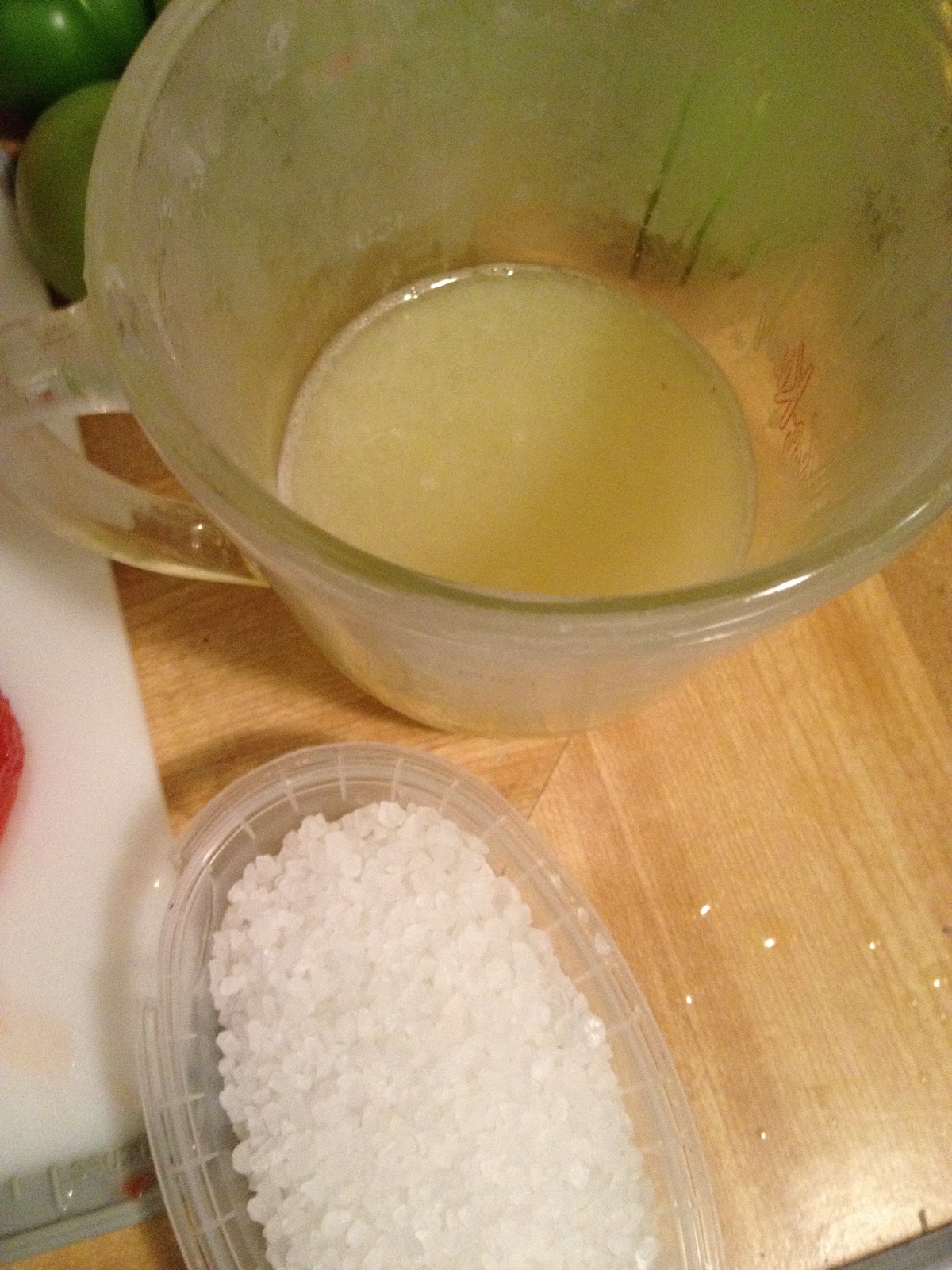
Put some lemon juice (about 1 tablespoon per quart jar) and some salt into each jar. I only used a pinch of salt based on the size of the jar - a bigger pinch for a quart, a smaller pinch for a pint. I don't like to add too much sodium to anything.


Once the jars are packed, ladle some of the boiling "tomato immersion" water into the jars until there's only a half inch of space to the top of the jar. Then, slide the handle of your ladle or a spatula down inside the jar along the glass. Push the tool in toward the center of the contents to release any trapped air in the jar - working your way around the jar a few times. It's important to note that you can also simply "tap" the bottom of the jar on the counter to remove air but you run the risk of splashing the boiling water and/or cracking your jar(s).

Finally, take a lid from the hot water bath (you forgot about these, didn't you?) and place on the filled jar. Finger-tighten a band on the jar to hold the lid in place. Now, place your jars into the immersion rack.

Ready to take a bath!

In the canning pot
Make sure there are about two inches of water above the tallest jar in your pot. Bring back up to a slow, steady boil with the lid on and "cook" for the correct time for your jar size. In my case, because I did three different jar sizes, I had to remove the half-pints at 30 minutes, the pints at 40 minutes, and the quarts at 45 minutes.

Once the time is up, carefully (I cannot stress this enough) take the boiling-hot jar out of the water and place on a towel in a place where the jar can remain undisturbed for at least 12 hours. There's actually a tool for removing the jars from the water. I would highly recommend buying one of these. Once the jars are cooled for 12-24 hours, the lid should be tight and unable to be removed by hand when the band is taken off. Also, the lid should be, sort of, indented and not be able to be "popped" when you push on it.


My first cans!

I actually used some of my diced tomatoes in a crock-pot ribs recipe the other night - so they only stayed in the jar for a few days before they got eaten. What I can't understand is why they don't cook to mush with all the boiling water, but they don't. They were awesome.

The process was surprisingly easy. It's just a little time consuming (mostly the cutting the tomatoes part) and a little messy. Were I to do it over, I certainly wouldn't pick 8pm on a weeknight to start. LOL But, overall, it was a fun process and one that I'm sure I'll do again. And, you know what? If I can can, you can too!

- Alex